The Protestant
Reformation ignited the canon that would become insecurity and doubt in the
beliefs and doctrines of the medieval Catholic Church. With the challenging of
the practices of selling indulgences, as detailed by Martin Luther in 1521, to
the dogma of papal infallibility in addition to the formation of new Christian
denominations and belief systems such as Calvinism and Lutheranism, followers of
the Christian faith were dazed and confused, to say the least. This sparked
disagreements and conflict between those living in the same area but following
different Christian denominations. Which denomination was most accurate in
their beliefs? Which denomination was superior to all others? Followers of each
different group believed that theirs was superior, and all others failed in
comparison.
 |
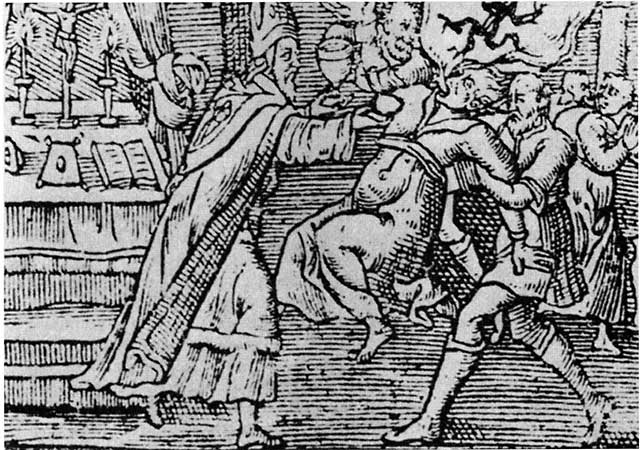
| A priest performing an exorcism on an accused witch. |
In areas where
Catholicism was prevalent, there was persecutions of Protestants, and vice
versa. In order to justify these persecutions – which often were murderous –
the perpetrators did so under the guise of prosecuting and eradicating those found
practicing witch craft. In The Witch-Hunt
in Early Modern Europe, historian Levack states that “if witch-hunting was
more widespread and intense in areas that were religiously divided, then the
converse must also be true” (Levack 124). We can see from our class discussion
and readings that larger states, such as Spain and Italy, had many more
accusations than smaller states such as Portugal and Ireland.
The Reformation played a
key role in instigating the witch-hunts, and became a large catalyst due to the
invention of the printing press in 1440 that allowed for mass production of
texts such as Luther’s Ninety-Five Theses
which challenged the standard beliefs and practices at the time. This begs the
question of whether any of the witch-hunts were truly due to thoughts of witch
craft and acts of one doing nothing other than using magic and to cause
malicious harm to someone, or if they were simply executing their own beliefs
that were challenged and taboo at the time.
Image credit:
http://williameamon.com/wp-content/uploads/2011/04/Woodcut-1598-witch-trial.jpg