Thursday, December 3, 2015

Modern-Day Indian Witch-Hunts

In August of this year, residents of a village in Jharkhand state, India were subjected to fatal abductions from their homes, and severe beating. These residents, five women, were all accused of practicing witchcraft and were then blamed for unlucky accidents that occurred throughout the village.

Superstitious beliefs fueled these attacks, and prompted the death of these women. The beliefs of those we’ve studied throughout the semester also – coupled with economic problems, political unrest, and a plethora of other factors – were victimized and suffered as a result of their actions, and of accusations thrown against them. Through our studies, we’ve seen women accused of witchcraft for poor weather patterns, illnesses, reduced crop growth, and many other qualms that still occur today.

With the arrest of fifty villagers involved in the attack, this would appear to be a larger incident in a smaller village. We’ve seen mass prosecutions occur, such as in Basque and Wurzburg, which make these numbers seem like drops in a bucket in comparison, they are still lives that have been taken too soon, and taken forcefully by others. 

Image credit:
http://assets.nydailynews.com/polopoly_fs/1.2319281.1439065843!/img/httpImage/image.jpg_gen/derivatives/article_970/543197240.jpg?enlarged

Witch Hunts in Europe vs Witch Hunts in Africa

A laymen would believe the witch-hunts in Europe to be a backwards, disorganized affair. However time and time again it shown that the witch-hunts in Europe were a very legalized, record based process. The witch-hunts would never have taken off and been as widespread without the growth of the legal powers of the church and state. Only when inquisitors were given the ability to coerce "information" out of the accused "witches" could the ideas behind the cumulative concept become legitimate and widespread. (Levack 304-305)

In Europe there were tens of thousands of of prosecutions, which can be attributed to the legal process. In Africa however while there have been witch-hunts and witch cleansing, they have not reached the heights that they did Europe. This can in part be attributed to cultural differences and the lack of Christian influence in Africa. Levack seems to argue however that it was in fact a lack of a legal process in Africa that has kept the numbers of the accused from reaching dramatic levels. In Africa the prosecutions and executions were all in the form of vigilante justice. There was no legal process and no torture therefore the cumulative concept could never take root in Africa.

Are there any other reasons that witch-hunts in Africa did not reach dramatic levels?
What other differences do we see between European witch-hunts and African witch-hunts? 

Tuesday, December 1, 2015

Witch-hunts and the Modern State

      An interesting aspect of the reading by Levack is that although the specific hunting of witches has for the most part ended in western nations the same processes that caused it remain. The fear of modern social deviants has resulted in similar persecution as those perceived to be witches in early modern Europe. In the United States there were witch-hunts for communists during the Cold War and in Europe during Nazi occupation, Jews and other social and ethnic minorities were persecuted to an extent that dwarfs the persecutions experienced by perceived witches in the past. The main difference between the witch-hunts of early modern Europe and those that have happened more recently or could potentially happen in the future is that it is the modern state in western society that is mainly persecuting "witches". Should they be they members of a particular ideology contrary to their government's positions or styled terrorists the people now representing witches can be persecuted on a much larger scale than was ever possible when it was mainly local communities who were responsible for persecutions. Although witches are not necessarily being persecuted currently, the the capacity for witch-hunt style persecutions against others is just as great now as it was during the early modern era in Europe.    


Do you believe that mass persecution in the style of witch-hunts is possible today? How is it that the change in the source of the persecution from local communities to the state has changed the groups being targeted for mass persecution?

Sunday, November 29, 2015

The Decline of Witch-Hunting

I have always supported the idea that the use of torture perpetuated the witch-hunts and was one of the most important factors that kept the witch-hunts alive for as long as they were. In the 17th and 18th century however the widespread witch-hunts began to dwindle, so much so that by 1782 the last officially sanctioned witch execution took place. (Levack 253) This decline and eventual end is largely thanks to the prohibition of torture. In the 17th and 18th century many critics of torture began to emerge, deeming it an inefficient method for obtaining information, pointing out its many flaws. One such critic was Christian Thomasius, Thomasius is quoted saying "I am afraid that if someone tortures you or me, we will confess to everything that the torturer wants to demand." (Kors and Peters 447) As more and more ideas similar to these began to emerge pressure was put on administrations that utilized torture until it eventually subsided.

Why do you think critics of torture took so long to emerge or vocalize?
What other aspects helped lead to the decline of the witch-hunts?

Sunday, November 22, 2015

Roper's enlightened witch-trials

Tomorrow's reading in Roper is about the influence of the Enlightenment and how it changed the ideas and proceedings of witch interrogations and trials.The trial of Catharina Schmid is a focus of Roper and used to display her argument from the beginning to the middle of the chapter. As Roper explains, Catherina's trial which took place in southern Germany, used torture that violated rules, was targeted towards an elderly woman (74 years old), and displayed a separation between the lower class (Schmid) and the upper (Roper, 227 and 231). However there is a new significance to this case. As Roper explains, this case took place in 1745 which was over 100 years after the attributed end to the witch crazes that caused mass panic and executions and with the Enlightenment came an increase in record keeping (Roper, 228). Her major point through all of this is the detail of the emotion that scribes recorded through the entire process. Although the trials followed a similar format, instead of focusing on the confessions the scribes during the Enlightenment focused on the testimonies of others throughout the case. Why would there be such a drastic change in focus for proof? Roper briefly explains that due to the long break between 1650 and the reemergence of witch-trials in the 18th century the court systems had to redesign their tactics because they didn't have access to many of the original doctrine (Roper, 231). As a student of history I would like to believe that people learn from previous history. Thereofore, and I think this is what Roper is trying to argue as well, because of the lack of records concerning the search for proof there was an increase in displaying this process and what people said through the trial for future generations to come. Within her chapter she also discusses the Enlightenment and some other characteristics that influenced the witch-trials, briefly what are these new ideas? Also, if at the end of these witch hunts, just like those earlier in the 16th and 17th centuries, there were still executions of people were these changes truly significant?


source: Roper, Lyndal. Witch Craze. New Haven: Yale University Press, 2004.


Wednesday, November 18, 2015

“Not So Serious…” The Spanish Inquisition and Witches

   Oftentimes the Spanish Inquisition gets a bad rap. Even though countless individuals were persecuted for being Jewish or Muslim, no one can argue that a plethora of people were victimized by means of a bloody purge to rid Iberia of witchcraft and magic. On the contrary, a small percentage of the total number of people accused and brought before inquisitorial courts during the period between 1540 and 1700 were charged with Superstition and Witchcraft, according to Christina Larner (CP, 2015). Out of almost 45,000 total charges only 3,500, or roughly 8%, were based on witchcraft and magic. Furthermore out of 535 executions in the region of Aragon during 1540-1640, a measly 12 souls lost their lives because of accusations of superstition and witchcraft, most receiving the “mildest penalties [of]… confession and absolution,” (qtd. in CP, 2015).
    Although any loss of life is a sad occurrence, the numbers in Spain illustrate a significant downplay compared from the massive witch-hunts that were occurring in northern Europe during this time. While many of the magistrates over witch trials in northern Europe were secular, in Spain the Catholic “Inquisition had jurisdiction over all offenses involving… superstition and magic…” (qtd. in CP, 2015). It was in this role that the Inquisition presided over the cases of accused witches and magicians during the early modern period. Addressing the issue of the amount of severity that witches were dealt, or more accurately NOT dealt, resides in the common notion that individuals who were accused of witchcraft were actually attempting to invoke God’s power through the use of legitimate Church “magic”. Larner contends that many did not know that they were sinning and that had they of known it, they would have stopped. Moreover the “only reason that the [commoners’ practice of magic] did not qualify as Church ‘magic’ was that the practitioners violated the Church’s monopoly on divine access,” (qtd. in CP, 2015).
    Needless to say the leniency that accused witches in Spain received during the Inquisition nullifies the belief that all were treated with extreme harshness. Since most inquisitors “assumed that most accused of magic were sincere Catholics who truly did not knowingly call upon demons,” they would receive much lighter punishment compared to more serious offences such as heresy, sodomy, and opposition to the Inquisition (qtd. in CP, 2015).
 
An early 19th century engraving of what many experienced during
the Inquisition. However, according to Larner individuals who were accused of
witchcraft and superstition were almost always not subjected to torture.
Why was the main focus in Spain was on different issues than witchcraft and magic, while many other regions were focusing their attention on eradicating all forms of magic practice?

Do you feel that Spain’s recent past at the time contributed to the Inquisition’s attention to religious matters?

Source:

Wolbrink, Shelley, comp. Course Packet: History of European Witch-hunts. Springfield, Missouri: Drury University Carbon Copy, 2015.

Implicit Partnership: Witchcraft and the Atlantic World

Elizabeth Reis (CP 217) discusses the idea that witchcraft in America was often deemed as such even when it went against the standards laid out in the Malleus Maleficarum. While the American judicial system also used confessions to convict witches, they weren't looking for the same thing European Inquisitors were looking for. In Europe, if confessions didn't edify the notions that the Inquisitors already had about witchcraft, they generally weren't accepted.

In contrast, Reis writes, "Simply to sin implied the forging of an implicit covenant with Satan, a spiritual renunciation of God. For Puritans, to become an actual witch demanded the acceptance of a more literal and physical invitation from the devil. But during the Salem witchcraft trials and other episodes, these distinctions were blurred" (CP 218).

What do you think of this idea of implicit partnership? Does it remind you of any other readings we've done this semester? 

Sunday, November 15, 2015

Aberdeenshire: The Beginning of the Scotland Panic

Julian Goodare begins his article about the Scottish witchcraft trials with the trials about Slain which is in Aberdeenshire, Scotland. While reading his article I could only think about the common theme concerning the progression of persecution of witches. In Slain the panic, as Goodare calls it, began with the persecution of two women, Isobel Strachan and Janet Wishart. Both of these women were executed and following their executions panic developed.

It began with Wishart's son, Thomas Leys. He was interrogated, confessed and named many women who had been present whenever he was participating in his devil worshiping/witchcraft. Following Leys' confession led to the interrogation of these other women who also confessed upon interrogation and named more women. In the end the panic had grown exponentially. In a matter of 3 months, "At least eighty people [had been] caught up in the panic, thirty of whom died as a result of it," (Goodare, 2007). It is amazing to me how a panic can show the same characteristics of development even though it is secluded on the northern tip of an island away from the main land that is attributed to the masses of witch trials. Is this a result of the printing press that had been invented 100 or so years prior? I also wonder if the Reformation that sparked the spread of ideas from theologian to theologian, which was arguably made possible through the utilization of the printing press, also fostered the spread of news about trials in Germany and surrounding areas to further places such as Scotland? This could possibly explain some of the stark similarities between the trials. And, because both Germany and Scotland were hubs for some of the most influential protestant theologians it seems plausible.

Thursday, November 12, 2015

Evil Children or Mistreated Souls?

Children have historically embodied two very different personas as made evident by the readings on child witches. There is the stereotypical idea of a child that pops into our head; innocent, curious, fragile, and most certainly incapable of witchcraft. But then there is the "sinister" child, the child that whispers ominously and behaves strangely (think Damien from "The Omen"). This child is less frequently thought of, but nevertheless in the back of our minds. For example, something as seemingly innocent as a child's laughter can be both delightful and terrifying. If you're playing peek-a-boo with a child you can't get enough of their little giggle, but if you're home alone and you hear a child's laughter in the night, you're probably going to start praying--at least I would. Clearly there is something both eerie and adorable about children. Perhaps it's for this reason that mature, logical adults were easily able to believe children capable of being witches.

 In the case of Trier, when multiple children claimed to be witches, it is obvious they had no idea what they were doing, and were more than likely just playing pretend. Children love attention, and the mass amounts of attention they would have received during this trial would only serve to fuel the fire of what was most likely to them simply a game. We also know that children can be easily manipulated into giving false testimony, as in the ritual abuse cases of the 80's and 90's. If they feel pressured into it they would easily denounce their neighbors as witches, either out of fear, or because they thought it was fun. The idea of manipulation becomes even more likely when you factor in the fact that minors were allowed to be tortured. We know adults have a very difficult time withstanding torture, one can only imagine how much harder it must have been for a child.

Walinski-Kiehl, Robert S. "The devil's children: child witch-trials in early modern Germany." The History of European Witch-Hunts Course Packet, 2015. Print.

Save the Children: Child Witches During the "Witch Craze"

Children during the early modern period of the witch-trials seemed to have a major role, both passively and actively. In the beginning of Robert Walinski-Kiehl's article, he talks about how children were sometimes primarily seen as victims of witchcraft, rather than actual participants. Children were subjected to violent mutilation and violence as it was believed to be a major identifier for what makes a witch a witch (CP 195). However, Walinski-Kiehl quickly moves on to point out that there were, in fact, children that were tried and even executed because they themselves were accused of being witches.

While we do not seem to have a definitive number as to how many child witches were actually tried and executed, but the author does point out a series of accounts that have been documented of children confessing and accusing others of witchcraft. What I find most interesting about these accounts is trying to figure out just what exactly is going on in the children's psyche while the trials are in full swing. Walinski-Kiehl explains that while children obviously carry an air of innocence about them, and that these shocking accusations of the witch-trials might be far beyond their ability to understand, the author explains, "However, it is unlikely that children were completely unfamiliar with demonic witchcraft notions, particularly in areas that experienced mass panics. They would have overheard adult conversations discussing the trials, and they had the opportunity to obtain information by attending the public executions where the witches' demonic confessions were read out aloud" (CP 202). The children may very well know some of the mechanics of the witch-trials, but they may not know exactly what the trials mean on a deeper level of understanding.

But what do you think of the child confessions? Where do you suppose they stem from, based on our readings for today, and/or any experience you might have with children?


Walinski-Kiehl, Robert S. "The devil's children: child witch-trials in early modern Germany." The History of European Witch-Hunts Course Packet, 2015. Print.

Tuesday, November 10, 2015

The Many Faces of Possession

The origin of demonic possession during the witch-hunts is one that has differing perspectives. Levack writes that possession was the caused by a witch and points out that a number of witch prosecutions can be attributed to the "witch" being accused of inflicting the possession on a large group of peoples (Levack 184). On the other hand Johann Weyer believed that the Devil possessed the afflicted directly, not as a result of witchcraft. (CP 187)

Possession had reached its peak in Europe in the 1550's but its prominence in Colonial America was not until the late 17th century. A case of possession in Boston in 1688 led to a witchcraft trial and an eventual execution. Then there was the witch-hunt at Salem, this was a highly publicized event that led to a number of cases in England and Scotland. Cases like these helped cement the idea of possession and exorcism in the minds of generations to come and tales of possession are still seen today. 

The Exorcist or as I more commonly refer to it as "the reason I didn't sleep during the summer of 2000" is the most classic example of an exorcism/possession in pop culture today. A number of movies have tried to emulate its success, but I wouldn't know if they were good or not because I'm now permanently broken to scary movies. It seems that without fail there is a movie every year or two regarding this topic (my personal favorite being the exorcism of Jonah Hill in This Is The End).  


For those of you who are interested here is the Exorcism of Jonah Hill: 

Possession Then and Now

The perception of possession has changed drastically from the days of the witch hunts. Levack introduces the idea that possession was believed to be caused by a witch, and manifested specifically in nuns and children in large numbers. It's interesting to note that in the cases in Aixen-Province and Loudon, the culprit supposedly behind the nuns' possession was non other than the priest. Additionally, as Levack writes "according to demonological theory the Devil actually entered the body of the afflicted person rather than acting upon it externally".

Possession has become mainstream. Stories of exorcism have become box office hits. There are hundreds, if not thousands of scary movies out there that all deal with possession. Long gone are the days when we would cower in fear of the witch who could cause us to be possessed by the Devil. The "roles" in modern day possession have changed immensely. The witch has either disappeared completely, or been replaced by Satanists as is the case in the movies "Annabelle" and "Rosemary's Baby". No longer are large groups of people possessed, but rather one or two individuals, although usually not at the same time. The priest has gone from the evildoer to the much sought after savior as evidenced by the classic movie "The Exorcist". Perhaps most importantly, the role of the possessor has changed. Possession has been outsourced to demons, rather than being done by the Devil, I guess he's just too busy with other business. The idea of possession by demons holds true for all the popular possession movies released over the last 40 years. The one thing that doesn't seem to have changed is that women and children are still portrayed as the primary victims of possession.

Possession is no longer something we fear, because it's not something that is "real" to us. We see videos of supposed possession, and hear stories of people being possessed, but we don't really believe it's caused by a demonic entity. Science and modern medicine have given us ample ways of explaining symptoms of possession. People throwing up seemingly inedible objects such as bones, pins, or straw, is explained away by an eating disorder called Pica. Interestingly enough, Pica is most common among women and children. Schizophrenia explains why victims of possession might experience hallucinations, hear voices, or speak in "tongues". Unlike in the past, today possession is easily explained away.


Sunday, November 8, 2015

Social Statuses of Old Women as Portrayed in Art


                           The Bath of Leuk, 1597 by Hans Bock

   
     Old women in early modern Germany were a group of people that according to Roper were potentially a despised segment of society and this image called The Bath of Leuk illustrates this mentality in multiple ways. The younger women are shown as expressing fertility with some such as the woman in the foreground and others appearing pregnant. Pregnancy was an important feature of fertility during the time period and presents the younger women in a positive light. Another positive aspect of the younger women in the image is that they appear to be wealthier than the other women with expensive looking necklaces and many of them are attracting male attention or are at least interacting with with others in the image. All of these attributes contrast with the older women portrayed in the image. The older women portrayed in this image are not socially interacting with anyone else in the image nor seem to be particularly enjoying themselves in contrast to basically everyone else in the image. The older woman on the far left with her arms crossed appears to be among only women in the image to not have a necklace of some type implying a difference in wealth between her and the younger fertile women in the scene. All of these differences between the older women and the younger serve to illustrate the mindset of German society at the time of old women as different from the rest of society. 


Why is it that you think that old women in German society during the early modern era were targeted for witchcraft? Was it primarily about fertility or something more?                

Envious Ol’ Hags: Fertility, Age, and the Witch-Hunts

Albrecht Dürer: Witch riding backwards on a goat,
copperplate engraving (repro-negative), c. 1505
Witches are old, ugly haggish women. At least that is a common viewpoint of the twenty-first century. However this is not a time bound phenomenon according to Lyndall Roper. The author, whose 2004 book Witch Craze focuses on the psychological aspects of the witch-hunts that occurred throughout Europe over the 400 years from the fifteenth century forwards. Looking at the accounts of torture and executions that were committed during the era, Roper constructs her argument that “older women were strongly over-represented amongst the victims of the witch craze,” (Roper, 161). Official records illustrate that the majority of women prosecuted for witchcraft were older than age forty and largely the women had experienced motherhood. One example of this is the town of Nördlingen, Germany during the years 1589-98 where there were 35 individuals which were executed as witches. All but one were female, and roughly twenty of those women were at least forty years old with an additional six having had adult children. Similar incidences occurred throughout Europe during the period, leading to Roper’s conclusion that fertility played a significant role in contributing to the witch-hunts. She contends that older women, especially menopausal and post-menopausal were more likely to be accused of being witches due to the fact that they were more likely to be envious of young mothers who were in the prime of their life. Furthermore society’s expectations regarding women’s roles as being rooted in fecundity would contribute to the negative view of older and sterile women.

Why do you think that so much emphasis was placed on fertility and infertility during this era? Was it just social beliefs/traditions or was there a more calculated, logical reason?

Roper, Lyndal. Witch Craze: Terror and Fantasy in Baroque Germany. 1st ed. New Haven: Yale UP, 2004. Print.

Friday, November 6, 2015

Regulations in Society

Regulating fertility and marriage was a big part of early modern history. In Roper's chapter on Fertility one of the most common regulations for marriage was being financially stable. Not only was it required that you be in a financially stable position but also that you weren't too young. Of course with age comes more money such as if a parent dies and one inherits the assets. One of the regulations was even that they didn't want you marrying an "outsider" or the example Roper gives, you must show documentation of the properties owned by the person you wish to marry. One man was denied the marriage to a woman for not being able to provide documentation. For regulations on fertility it's pretty reasonable to regulate the amount of births in a community due to food shortages or something of that matter. It would be much harder in today's world but as adults we can make that decision ourselves based on our situations in life. We may read this chapter and think how can they put regulations on fertility and the birth of children let alone who you fall in love with and the denial of marriage. But is it all that crazy? If we think about it our parents tell us as we are growing up not to get married to young and that we need to save money as we go so that we will have a comfortable lifestyle. Although there is no actual law regulating this I think we still follow these guidelines in today's world.

Regulations on Fertility and Marriages

Regulations on Fertility and Marriages
Regulations and rules were put on marriages and fertility because of the wide fear of witches and this way they can have some control over society.  Limiting population was a concern for the early modern government because of the lack of resources and the down fall of the economy. Keeping population down was important because the resources, like food, were limited. To be able to get married a couple must be financially stable and able to provide from themselves. This helped to decrease fertility by making couples wait to marry and to have children sooner. As woman age it is harder for them to conceive and by making them wait there is a less chance they will have multiple children. Parental permission was another regulation on marriages, if two people decided to get married without permission it was considered ‘irresponsible marriage’ (Roper 129). There are multiple rules that stop fertility and marriages throughout Germany.
In this chapter Roper used many images that displayed fertility, which was a common theme in many witch trials. The painting Allegory of Nature displays the connection between human fertility and the earths fertility. Like woman providing for her children the earth provides nourishment when the time comes. During this time the earth was not as fruitful and there for woman could not bear as many children.
What did you think about the images that Roper displayed in chapter six?

What did you think about the regulations and restrictions on marriages and fertility? 

Thursday, November 5, 2015

Post-Partum Depression and Fertility

As I read Roper's chapter on womanhood, I'm realizing just how many risks, both real and imagined, surrounded a pregnancy. First you have the worry that you may miscarry, if you manage to reach birth, then the mother, child, or both might end up dying, and if you're lucky enough to make it to the laying in period, well your child may end up being killed by a witch. Roper's accounts of the "terrors, anxieties and dependence" brought about by the childbed makes me wonder whether post-partum depression played a part in the accusations of witchcraft. We know from prior readings about guilt transfer, and from the actions surrounding the "satanic abuse" cases, just how heightened a mother's sense of guilt can be. I wonder if perhaps feelings brought on by post-partum depression would cause a new mother to feel extremely guilty, and therefore try to transfer her guilt onto someone else if something happens to her baby.
The government crackdown on marriage and illegitimacy, combined with the need to continue lineages and the population overall, caused quite a catch 22. One can see why fertility became so important. By having to wait longer for marriage, a woman decreased her likelihood of having children and in conjunction with the high infant mortality rates, women of the time became less and less likely to have living children. Without knowing that her "advanced" age would have an effect on how many children she would bear, its easy to see why a jealous witch may want to steal what fertility she has left.

Roper 126-159

Tuesday, November 3, 2015

Midwives, Stepmothers, and the Old Crone Who Lives Next Door

The image of a witch as an old crone is incredibly pervasive today, just as it was in the early modern period. Today witches in popular culture are almost invariably presented as old women, sometimes supernaturally ancient and sometimes just old. Witches (understandably) are cast as the antagonists, the villains, and in many cases witches were close to the protagonist or their family members prior to becoming evil or their powers revealed (think Snow White and Into the Woods).
These associations have firm roots in the witch hunts of early modern Europe, when the majority of those tried for maleficia were women and the average age exceeded 50, even 60 years of age in some regions. Thus, the average witch could be understood to be a menopausal or postmenopausal woman. The association of witches with fertility is an ancient one, brought about when pagan fertility rites became heretical with the popularization of Christianity.
Mothers and midwives were a natural extension of the fertility association, and while Levack points out that the image of a witch as a midwife was less common in the early modern period than modern associations would have one believe, he also brings up the idea of family members accusing each other of witchcraft as an allowable vengeance in the early modern period. Accusations of this sort, such as a young person accusing their mother, stepmother, or another older female family member of witchcraft as payback for her opposing an early marriage, were not common per se, but were definitely not unheard of.

Thinking about witches in modern popular culture, what might be some historical bases for the way they are presented today?

Levack, 141-163.

Thursday, October 29, 2015

A Most Horrifying "Scandal"

This week's reading hasn't been easy. With the topic of torture we like to think that we are somehow separated from that of the witch-hunts, but that is not entirely true. Photos and recorded documents of the Abu Ghraib incident prove that.
During the war in Iraq, military personnel stationed at Abu Ghraib prison were said to have abused detainees with various forms of torture and sexual violence. It was said that these acts of torture were used as a means of gathering information, such as in the incidents of the witch-hunts. What is also similar to the witch-hunts, is that torture was authorized by government military leaders. "There was evidence that authorization for the torture had come from high up in military hierarchy, with allegations being made that Secretary of Defense Donald Rumsfeld had authorized some of the actions" (Wikipedia).
As we have read before, many people react differently to the topic of torture and with this incident in particular. In the "Global Reaction" section of the Wikipedia article, it quotes Archbishop Giovanni Lajolo, the foreign minister of the Vatican, saying that this incident at Abu Ghraib was "a more serious blow to the United States than September 11, 2001 attacks. Except that the blow was not inflicted by terrorists but by the Americans against themselves" (Wikipedia). This means that since the incident has proven that the United States is in fact willing to use torture, that the rest of the world will look on the country very poorly, and possibly even encourage new enemies. However, many people also responded in favor of the torture, saying that if it is necessary, it should be used.

These might be a hard questions to ask, but what do you think of the whole "scandal"?

Do you think that torture should be permitted as a means of gaining information?

"Abu Ghraib torture and prisoner abuse." Wikipedia.org.

Wednesday, October 28, 2015

Misogyny, Misandry, or Misanthropy: Gender Bias in the Early Modern Witch-Hunts

In our class discussions, we critically analyze the causes, effects, and parties involved in the medieval European witch-hunts. At times, such as when viewing woodcuts and illustrations such as the cover of our Kors and Peters book, depicted below, we also address the concept of gender and the role that it played. We see that the vast majority of those accused of witchcraft were females, the majority of those prosecuting and investigating such accusations were males, and we see two stark contrasts between the punishments awarded to these groups.
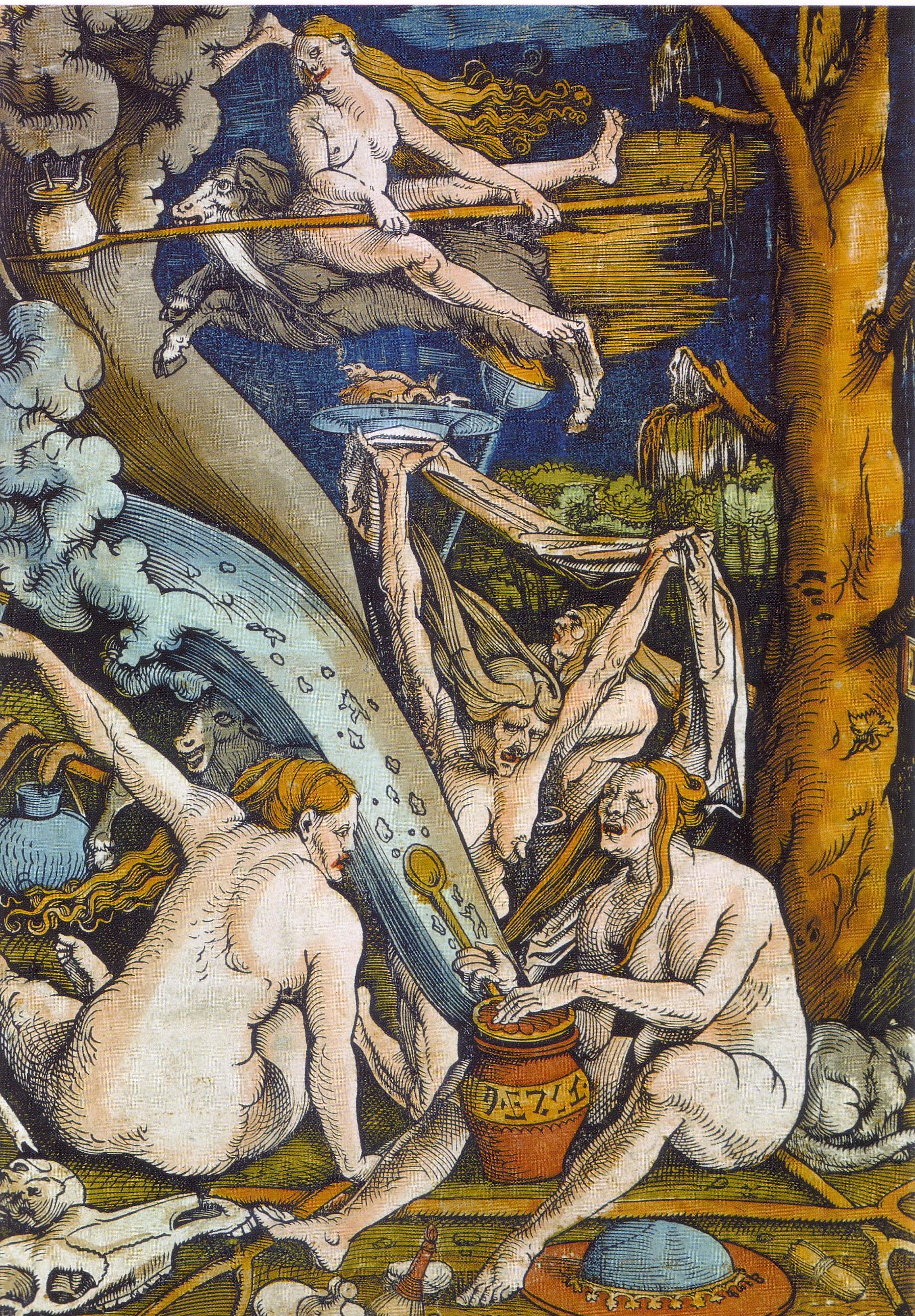
The word misogyny is often used far more often than is necessary or than is appropriate. Yes, our studies and texts in class primarily focus on those who lack a Y chromosome, but it does not solely focus on punishing only those individuals. Misandry is a concept that is often ignored, many don’t want to speak of the oppression, contempt, and prejudice that are held against men throughout various aspects of history and in our modern day. As opposed to labeling the entire scope of the witch-hunts as being misogynistic, or misandristic, a much more adequate and fitting term would be misanthropic.  

In our Kors and Peters book, we read the Malleus Maleficarum written by Heinrich Kramer. In this text, which quickly became paramount to the witch hunts, both men and women are described in how they succumb to the practice of witchcraft, and goes so far as to explain and justify the reasoning behind why women were more often accused, such as claiming “women are more carnal than men,” “women are more easily swayed and influenced,” and “a woman falsely accused Joseph which resulted in his incarceration because he refused to engage in intercourse with her, thus they are more likely to act out in jealousy or envy and turn to evil methods in order to achieve such means” (K&P).  


Although there aren’t any current studies heavily examining gender and the representation of each and every accused individual in these hunts, in order to fully understand the implications of one’s sex and certain body parts that they may or may not have, one first needs to understand and come to view gender as more of a spectrum than a binary, in addition to concepts such as human sexuality. Why does the Bible condemn homosexuality and acts of sodomy? Why were such acts punished during these hunts? If two consenting adults choose to engage in private activities, even if one of those adults happens to be a demonic or evil entity, what exactly gives the rights to these inquisitors and these magistrates to pass physical judgment and execute, fine, or otherwise punish these individuals? Why were Catholics able to prosecute Jews, Waldensians, and pagans?


Although the majority of these prosecutions and interrogations were reserved for women, in order to fully understand the implications and scope of the witch-hunts, men and their roles as accused cannot be overlooked. 

Image credits:
Baldung/Kors and Peters image:
https://upload.wikimedia.org/wikipedia/commons/0/07/Baldung_Hexen_1508_kol.JPG
Malleus Maleficarum image:
https://upload.wikimedia.org/wikipedia/commons/thumb/f/f8/Malleus.jpg/250px-Malleus.jpg
Bibliography:
Kors, Alan Charles, and Edward Peters. Witchcraft in Europe, 400-1700: A Documentary History. Second ed. Philadelphia, Pennsylvania: University of Pennsylvania Press, 2001.