Thursday, November 12, 2015

Save the Children: Child Witches During the "Witch Craze"

Children during the early modern period of the witch-trials seemed to have a major role, both passively and actively. In the beginning of Robert Walinski-Kiehl's article, he talks about how children were sometimes primarily seen as victims of witchcraft, rather than actual participants. Children were subjected to violent mutilation and violence as it was believed to be a major identifier for what makes a witch a witch (CP 195). However, Walinski-Kiehl quickly moves on to point out that there were, in fact, children that were tried and even executed because they themselves were accused of being witches.

While we do not seem to have a definitive number as to how many child witches were actually tried and executed, but the author does point out a series of accounts that have been documented of children confessing and accusing others of witchcraft. What I find most interesting about these accounts is trying to figure out just what exactly is going on in the children's psyche while the trials are in full swing. Walinski-Kiehl explains that while children obviously carry an air of innocence about them, and that these shocking accusations of the witch-trials might be far beyond their ability to understand, the author explains, "However, it is unlikely that children were completely unfamiliar with demonic witchcraft notions, particularly in areas that experienced mass panics. They would have overheard adult conversations discussing the trials, and they had the opportunity to obtain information by attending the public executions where the witches' demonic confessions were read out aloud" (CP 202). The children may very well know some of the mechanics of the witch-trials, but they may not know exactly what the trials mean on a deeper level of understanding.

But what do you think of the child confessions? Where do you suppose they stem from, based on our readings for today, and/or any experience you might have with children?


Walinski-Kiehl, Robert S. "The devil's children: child witch-trials in early modern Germany." The History of European Witch-Hunts Course Packet, 2015. Print.

Tuesday, November 10, 2015

The Many Faces of Possession

The origin of demonic possession during the witch-hunts is one that has differing perspectives. Levack writes that possession was the caused by a witch and points out that a number of witch prosecutions can be attributed to the "witch" being accused of inflicting the possession on a large group of peoples (Levack 184). On the other hand Johann Weyer believed that the Devil possessed the afflicted directly, not as a result of witchcraft. (CP 187)

Possession had reached its peak in Europe in the 1550's but its prominence in Colonial America was not until the late 17th century. A case of possession in Boston in 1688 led to a witchcraft trial and an eventual execution. Then there was the witch-hunt at Salem, this was a highly publicized event that led to a number of cases in England and Scotland. Cases like these helped cement the idea of possession and exorcism in the minds of generations to come and tales of possession are still seen today. 

The Exorcist or as I more commonly refer to it as "the reason I didn't sleep during the summer of 2000" is the most classic example of an exorcism/possession in pop culture today. A number of movies have tried to emulate its success, but I wouldn't know if they were good or not because I'm now permanently broken to scary movies. It seems that without fail there is a movie every year or two regarding this topic (my personal favorite being the exorcism of Jonah Hill in This Is The End).  


For those of you who are interested here is the Exorcism of Jonah Hill: 

Possession Then and Now

The perception of possession has changed drastically from the days of the witch hunts. Levack introduces the idea that possession was believed to be caused by a witch, and manifested specifically in nuns and children in large numbers. It's interesting to note that in the cases in Aixen-Province and Loudon, the culprit supposedly behind the nuns' possession was non other than the priest. Additionally, as Levack writes "according to demonological theory the Devil actually entered the body of the afflicted person rather than acting upon it externally".

Possession has become mainstream. Stories of exorcism have become box office hits. There are hundreds, if not thousands of scary movies out there that all deal with possession. Long gone are the days when we would cower in fear of the witch who could cause us to be possessed by the Devil. The "roles" in modern day possession have changed immensely. The witch has either disappeared completely, or been replaced by Satanists as is the case in the movies "Annabelle" and "Rosemary's Baby". No longer are large groups of people possessed, but rather one or two individuals, although usually not at the same time. The priest has gone from the evildoer to the much sought after savior as evidenced by the classic movie "The Exorcist". Perhaps most importantly, the role of the possessor has changed. Possession has been outsourced to demons, rather than being done by the Devil, I guess he's just too busy with other business. The idea of possession by demons holds true for all the popular possession movies released over the last 40 years. The one thing that doesn't seem to have changed is that women and children are still portrayed as the primary victims of possession.

Possession is no longer something we fear, because it's not something that is "real" to us. We see videos of supposed possession, and hear stories of people being possessed, but we don't really believe it's caused by a demonic entity. Science and modern medicine have given us ample ways of explaining symptoms of possession. People throwing up seemingly inedible objects such as bones, pins, or straw, is explained away by an eating disorder called Pica. Interestingly enough, Pica is most common among women and children. Schizophrenia explains why victims of possession might experience hallucinations, hear voices, or speak in "tongues". Unlike in the past, today possession is easily explained away.


Sunday, November 8, 2015

Social Statuses of Old Women as Portrayed in Art


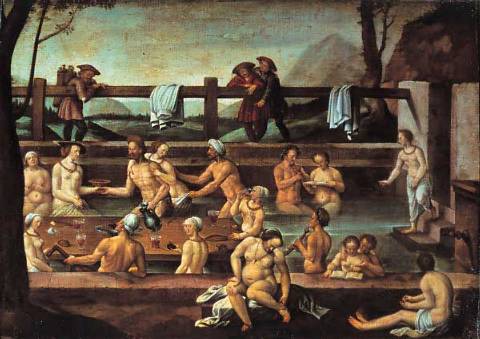
                           The Bath of Leuk, 1597 by Hans Bock

   
     Old women in early modern Germany were a group of people that according to Roper were potentially a despised segment of society and this image called The Bath of Leuk illustrates this mentality in multiple ways. The younger women are shown as expressing fertility with some such as the woman in the foreground and others appearing pregnant. Pregnancy was an important feature of fertility during the time period and presents the younger women in a positive light. Another positive aspect of the younger women in the image is that they appear to be wealthier than the other women with expensive looking necklaces and many of them are attracting male attention or are at least interacting with with others in the image. All of these attributes contrast with the older women portrayed in the image. The older women portrayed in this image are not socially interacting with anyone else in the image nor seem to be particularly enjoying themselves in contrast to basically everyone else in the image. The older woman on the far left with her arms crossed appears to be among only women in the image to not have a necklace of some type implying a difference in wealth between her and the younger fertile women in the scene. All of these differences between the older women and the younger serve to illustrate the mindset of German society at the time of old women as different from the rest of society. 


Why is it that you think that old women in German society during the early modern era were targeted for witchcraft? Was it primarily about fertility or something more?                

Envious Ol’ Hags: Fertility, Age, and the Witch-Hunts

Albrecht Dürer: Witch riding backwards on a goat,
copperplate engraving (repro-negative), c. 1505
Witches are old, ugly haggish women. At least that is a common viewpoint of the twenty-first century. However this is not a time bound phenomenon according to Lyndall Roper. The author, whose 2004 book Witch Craze focuses on the psychological aspects of the witch-hunts that occurred throughout Europe over the 400 years from the fifteenth century forwards. Looking at the accounts of torture and executions that were committed during the era, Roper constructs her argument that “older women were strongly over-represented amongst the victims of the witch craze,” (Roper, 161). Official records illustrate that the majority of women prosecuted for witchcraft were older than age forty and largely the women had experienced motherhood. One example of this is the town of Nördlingen, Germany during the years 1589-98 where there were 35 individuals which were executed as witches. All but one were female, and roughly twenty of those women were at least forty years old with an additional six having had adult children. Similar incidences occurred throughout Europe during the period, leading to Roper’s conclusion that fertility played a significant role in contributing to the witch-hunts. She contends that older women, especially menopausal and post-menopausal were more likely to be accused of being witches due to the fact that they were more likely to be envious of young mothers who were in the prime of their life. Furthermore society’s expectations regarding women’s roles as being rooted in fecundity would contribute to the negative view of older and sterile women.

Why do you think that so much emphasis was placed on fertility and infertility during this era? Was it just social beliefs/traditions or was there a more calculated, logical reason?

Roper, Lyndal. Witch Craze: Terror and Fantasy in Baroque Germany. 1st ed. New Haven: Yale UP, 2004. Print.

Friday, November 6, 2015

Regulations in Society

Regulating fertility and marriage was a big part of early modern history. In Roper's chapter on Fertility one of the most common regulations for marriage was being financially stable. Not only was it required that you be in a financially stable position but also that you weren't too young. Of course with age comes more money such as if a parent dies and one inherits the assets. One of the regulations was even that they didn't want you marrying an "outsider" or the example Roper gives, you must show documentation of the properties owned by the person you wish to marry. One man was denied the marriage to a woman for not being able to provide documentation. For regulations on fertility it's pretty reasonable to regulate the amount of births in a community due to food shortages or something of that matter. It would be much harder in today's world but as adults we can make that decision ourselves based on our situations in life. We may read this chapter and think how can they put regulations on fertility and the birth of children let alone who you fall in love with and the denial of marriage. But is it all that crazy? If we think about it our parents tell us as we are growing up not to get married to young and that we need to save money as we go so that we will have a comfortable lifestyle. Although there is no actual law regulating this I think we still follow these guidelines in today's world.

Regulations on Fertility and Marriages

Regulations on Fertility and Marriages
Regulations and rules were put on marriages and fertility because of the wide fear of witches and this way they can have some control over society.  Limiting population was a concern for the early modern government because of the lack of resources and the down fall of the economy. Keeping population down was important because the resources, like food, were limited. To be able to get married a couple must be financially stable and able to provide from themselves. This helped to decrease fertility by making couples wait to marry and to have children sooner. As woman age it is harder for them to conceive and by making them wait there is a less chance they will have multiple children. Parental permission was another regulation on marriages, if two people decided to get married without permission it was considered ‘irresponsible marriage’ (Roper 129). There are multiple rules that stop fertility and marriages throughout Germany.
In this chapter Roper used many images that displayed fertility, which was a common theme in many witch trials. The painting Allegory of Nature displays the connection between human fertility and the earths fertility. Like woman providing for her children the earth provides nourishment when the time comes. During this time the earth was not as fruitful and there for woman could not bear as many children.
What did you think about the images that Roper displayed in chapter six?

What did you think about the regulations and restrictions on marriages and fertility?