As I read Roper's chapter on womanhood, I'm realizing just how many risks, both real and imagined, surrounded a pregnancy. First you have the worry that you may miscarry, if you manage to reach birth, then the mother, child, or both might end up dying, and if you're lucky enough to make it to the laying in period, well your child may end up being killed by a witch. Roper's accounts of the "terrors, anxieties and dependence" brought about by the childbed makes me wonder whether post-partum depression played a part in the accusations of witchcraft. We know from prior readings about guilt transfer, and from the actions surrounding the "satanic abuse" cases, just how heightened a mother's sense of guilt can be. I wonder if perhaps feelings brought on by post-partum depression would cause a new mother to feel extremely guilty, and therefore try to transfer her guilt onto someone else if something happens to her baby.
The government crackdown on marriage and illegitimacy, combined with the need to continue lineages and the population overall, caused quite a catch 22. One can see why fertility became so important. By having to wait longer for marriage, a woman decreased her likelihood of having children and in conjunction with the high infant mortality rates, women of the time became less and less likely to have living children. Without knowing that her "advanced" age would have an effect on how many children she would bear, its easy to see why a jealous witch may want to steal what fertility she has left.
Roper 126-159
Thursday, November 5, 2015

Tuesday, November 3, 2015
Midwives, Stepmothers, and the Old Crone Who Lives Next Door
The image of a witch as an old crone is incredibly pervasive today, just as it was in the early modern period. Today witches in popular culture are almost invariably presented as old women, sometimes supernaturally ancient and sometimes just old. Witches (understandably) are cast as the antagonists, the villains, and in many cases witches were close to the protagonist or their family members prior to becoming evil or their powers revealed (think Snow White and Into the Woods).
These associations have firm roots in the witch hunts of early modern Europe, when the majority of those tried for maleficia were women and the average age exceeded 50, even 60 years of age in some regions. Thus, the average witch could be understood to be a menopausal or postmenopausal woman. The association of witches with fertility is an ancient one, brought about when pagan fertility rites became heretical with the popularization of Christianity.
Mothers and midwives were a natural extension of the fertility association, and while Levack points out that the image of a witch as a midwife was less common in the early modern period than modern associations would have one believe, he also brings up the idea of family members accusing each other of witchcraft as an allowable vengeance in the early modern period. Accusations of this sort, such as a young person accusing their mother, stepmother, or another older female family member of witchcraft as payback for her opposing an early marriage, were not common per se, but were definitely not unheard of.
Thinking about witches in modern popular culture, what might be some historical bases for the way they are presented today?
Levack, 141-163.
These associations have firm roots in the witch hunts of early modern Europe, when the majority of those tried for maleficia were women and the average age exceeded 50, even 60 years of age in some regions. Thus, the average witch could be understood to be a menopausal or postmenopausal woman. The association of witches with fertility is an ancient one, brought about when pagan fertility rites became heretical with the popularization of Christianity.
Mothers and midwives were a natural extension of the fertility association, and while Levack points out that the image of a witch as a midwife was less common in the early modern period than modern associations would have one believe, he also brings up the idea of family members accusing each other of witchcraft as an allowable vengeance in the early modern period. Accusations of this sort, such as a young person accusing their mother, stepmother, or another older female family member of witchcraft as payback for her opposing an early marriage, were not common per se, but were definitely not unheard of.
Thinking about witches in modern popular culture, what might be some historical bases for the way they are presented today?
Levack, 141-163.
Thursday, October 29, 2015
A Most Horrifying "Scandal"
This week's reading hasn't been easy.
With the topic of torture we like to think that we are somehow
separated from that of the witch-hunts, but that is not entirely
true. Photos and recorded documents of the Abu Ghraib incident prove
that.
During the war in Iraq, military
personnel stationed at Abu Ghraib prison were said to have abused
detainees with various forms of torture and sexual violence. It was
said that these acts of torture were used as a means of gathering
information, such as in the incidents of the witch-hunts. What is
also similar to the witch-hunts, is that torture was authorized by
government military leaders. "There was evidence that
authorization for the torture had come from high up in military
hierarchy, with allegations being made that Secretary of Defense
Donald Rumsfeld had authorized some of the actions" (Wikipedia).
As we have read before, many people
react differently to the topic of torture and with this incident in
particular. In the "Global Reaction" section of the
Wikipedia article, it quotes Archbishop Giovanni Lajolo, the foreign
minister of the Vatican, saying that this incident at Abu Ghraib was
"a more serious blow to the United States than September 11,
2001 attacks. Except that the blow was not inflicted by terrorists
but by the Americans against themselves" (Wikipedia). This means
that since the incident has proven that the United States is in fact
willing to use torture, that the rest of the world will look on the
country very poorly, and possibly even encourage new enemies.
However, many people also responded in favor of the torture, saying
that if it is necessary, it should be used.
These might be a hard questions to ask,
but what do you think of the whole "scandal"?
Do you think that torture should be
permitted as a means of gaining information?
"Abu Ghraib torture and prisoner abuse." Wikipedia.org.
Wednesday, October 28, 2015
Misogyny, Misandry, or Misanthropy: Gender Bias in the Early Modern Witch-Hunts
In our class discussions,
we critically analyze the causes, effects, and parties involved in the medieval
European witch-hunts. At times, such as when viewing woodcuts and illustrations
such as the cover of our Kors and Peters book, depicted below, we also address
the concept of gender and the role that it played. We see that the vast
majority of those accused of witchcraft were females, the majority of those prosecuting
and investigating such accusations were males, and we see two stark contrasts
between the punishments awarded to these groups.
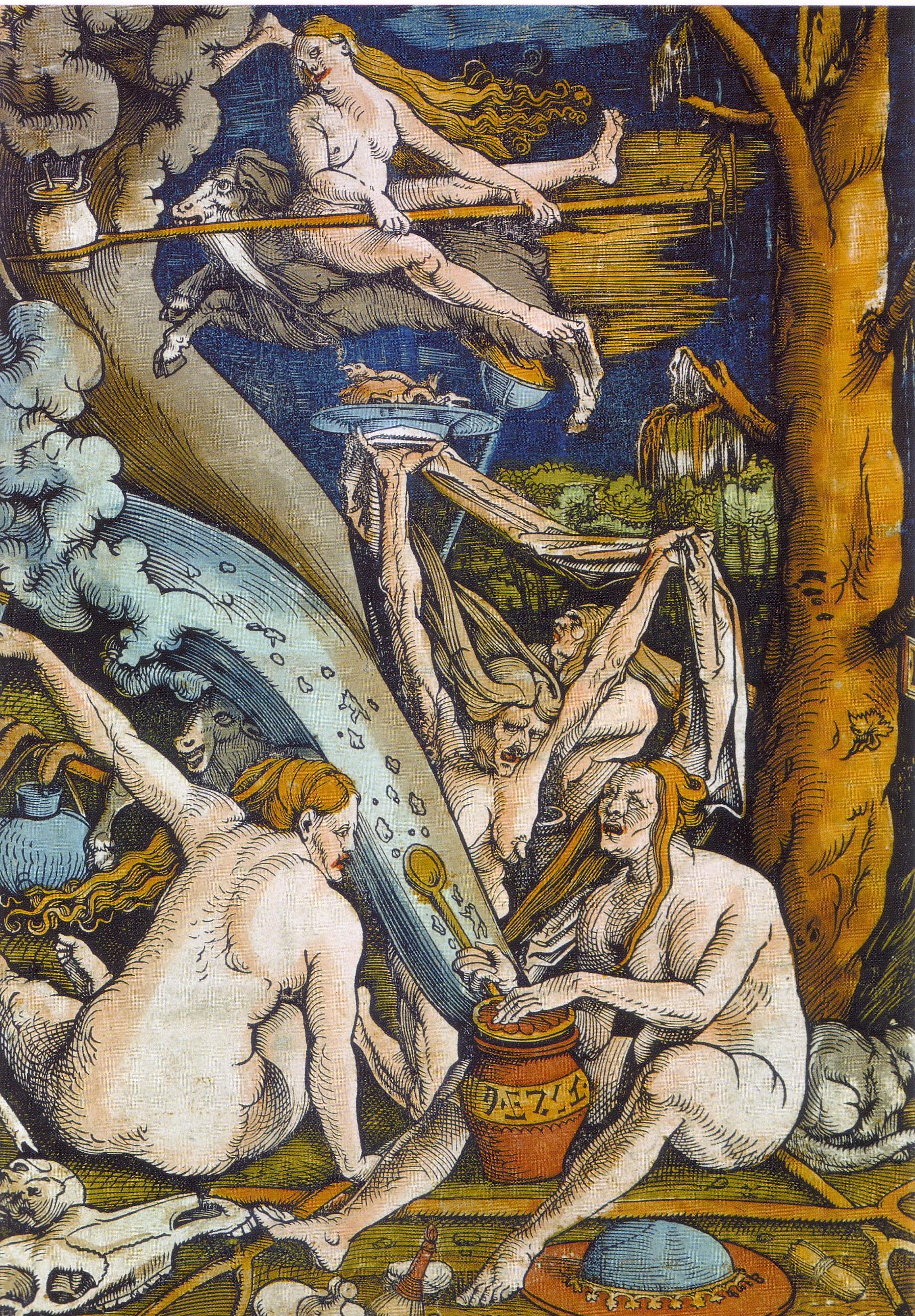
The word misogyny is
often used far more often than is necessary or than is appropriate. Yes, our
studies and texts in class primarily focus on those who lack a Y chromosome,
but it does not solely focus on punishing only those individuals. Misandry is a
concept that is often ignored, many don’t want to speak of the oppression,
contempt, and prejudice that are held against men throughout various aspects of
history and in our modern day. As opposed to labeling the entire scope of the
witch-hunts as being misogynistic, or misandristic, a much more adequate and
fitting term would be misanthropic.
In our Kors and Peters
book, we read the Malleus Maleficarum written
by Heinrich Kramer. In this text, which quickly became paramount to the witch
hunts, both men and women are described in how they succumb to the practice of
witchcraft, and goes so far as to explain and justify the reasoning behind why
women were more often accused, such as claiming “women are more carnal than
men,” “women are more easily swayed and influenced,” and “a woman falsely
accused Joseph which resulted in his incarceration because he refused to engage
in intercourse with her, thus they are more likely to act out in jealousy or
envy and turn to evil methods in order to achieve such means” (K&P).

Although there aren’t any
current studies heavily examining gender and the representation of each and
every accused individual in these hunts, in order to fully understand the implications
of one’s sex and certain body parts that they may or may not have, one first
needs to understand and come to view gender as more of a spectrum than a binary,
in addition to concepts such as human sexuality. Why does the Bible condemn
homosexuality and acts of sodomy? Why were such acts punished during these
hunts? If two consenting adults choose to engage in private activities, even if
one of those adults happens to be a demonic or evil entity, what exactly gives
the rights to these inquisitors and these magistrates to pass physical judgment
and execute, fine, or otherwise punish these individuals? Why were Catholics
able to prosecute Jews, Waldensians, and pagans?
Although the majority of
these prosecutions and interrogations were reserved for women, in order to
fully understand the implications and scope of the witch-hunts, men and their
roles as accused cannot be overlooked.
Image credits:
Baldung/Kors and Peters image:
https://upload.wikimedia.org/wikipedia/commons/0/07/Baldung_Hexen_1508_kol.JPG
Malleus Maleficarum image:
https://upload.wikimedia.org/wikipedia/commons/thumb/f/f8/Malleus.jpg/250px-Malleus.jpg
Bibliography:
Kors, Alan Charles, and Edward Peters. Witchcraft in Europe, 400-1700: A Documentary History. Second ed. Philadelphia, Pennsylvania: University of Pennsylvania Press, 2001.
Tuesday, October 27, 2015
Torture at Abu Ghraib
The photographs taken by the 372nd Military Police Company that shows detainees being tortured at Abu Ghraib are hard to look at. Male detainees were stripped naked, arranged in sexually explicit positions, and even forced to masturbate; all while being photographed or filmed. Many were beaten, waterboarded, and threatened with death. It is hard to believe that the United States could be responsible for such atrocities, but according to a Newsweek article titled The Debate Over Torture, it states that "The international Convention Against Torture, ratified by the United States in 1994, bans the "cruel, inhuman, and degrading" treatment of all prisoners. But Justice Department lawyers had obligingly declared that the president could ignore such constraints" (CP 166). It is also worth noting that many of these prisoners are not even prisoners at all, but rather considered enemy combatants that are not afforded the protection of the Geneva Convention rules. When the barbarity of what was happening at the prison came to light, an investigation was launched, and many of the lower ranking military members were sentenced to various lengths of jail time. One of the key components that came from the investigation was that "the 800th MP Brigade was not adequately trained for a mission that included operating a prison or penal institution at Abu Ghraib Prison Complex" (CP 160). Of course, those who were involved in the aggravated torture of the prisoners deserve to be punished, but do you believe that they were acting on their own, or were they merely following orders from higher command?
An American Alternative: Torture in the 21st Century
When one hears of torture, they immediately think
of the middle ages (incorrectly) or of the inhumane treatment by the Axis Powers
during the Second World War. However the use of torture is not a bygone
process. On the contrary torture has been found to have occurred in the last
decade. And the party responsible is not an uncivilized group or nation. The
assailants acted under the authority of none other than the United States’
Central Intelligence Agency. The individuals which were subjected to various
tortures – such as waterboarding, containment in small boxes, standing
handcuffed to hanging rods for weeks at a time – were prisoners who were
accused of being important leaders of the terrorist organization Al-Qaeda. The goal
of this torturing and subsequent interrogations was to extract information
regarding the identities of additional terrorists and potential targets. Although
there was much controversy regarding this use by the American forces to gain
information, the importance lies in the fact that the torture was not the
product of rogue subordinates in the field. What is more the decision to
utilize this form of extraction was decided by higher officials back in the
states.
In a 2009 article from the New York Times, a
C.I.A. officer stated that, “It wasn’t up to individual interrogators to decide…
[because every step] had to have the approval of the deputy director for
operations” (Danner). The officer continued that before any torture could be
done, those in the field had to ask permission via cable transmission of their
superiors (Danner, 2009). Thus it was beyond the power of the “boots on the
ground” to make the decisions about whether or not to apply torture to an
individual. The author of the article further writes that although there is
need for justice to be directed toward the alleged terrorists that “the use of torture
deprives society… of the possibility for rendering justice. Torture destroys
justice… in effect [relinquishing] this sacred right in exchange for
speculative benefits whose value is… much disputed” (Danner, 2009).
Essentially torture of terrorists would come to
be a major trouble in the American War on Terror, creating much highly
debatable results. There are many similarities that exist between the 21st
century and the early modern era when torture would be used to great extant to
withdraw information during the great witch-hunts. Looking back at the accounts
of the witch-hunts, what are the links that officials in power had over the
torture procedures? And do you feel that the information that is gained from
torture, whether in the present day or centuries ago, is truly beneficial to
the original intention of the torturers?
 |
| Early Modern Depiction of a Torture Technique that would be used in the 21st Century. |
To
read the New York Times article: http://www.nytimes.com/2009/03/15/opinion/15danner.html?_r=0
Monday, October 26, 2015
Damned if you do, Damned if you don't
As we have learned in class, it seems that people (especially women) who were accused of witchcraft had little to no rights when it came to their defense. From Rebecca Lemp, who's letters from her own children and husband could not save her, to Johannes Junius, a burgomaster from Bamberg, legal defense for accused witches appeared to be a "damned if you do, damned if you don't" scenario for them. Friedrich Spee, a confessor of witches wrote in the Cautio criminalis about a woman named Gaia. When it comes to living a good life or a bad life, he says "If a bad one, then, say they, the proof is cogent against her" and "If, however, she has led a good one, this also is none the less a proof; for thus, they say, are witches wont to cloak themselves and try to seem especially proper" (Kors and Peters 426). Usually, torture was used in order to obtain a confession. However, it doesn't seem to matter because, according to Spee, "when once a beginning has been made with the torture, the die is already cast - she cannot escape, she must die" (Kors and Peters 427). Even though there was the appearance of fairness (judges, lawyers, note takers, etc.), do you believe that those accused of witchcraft were doomed right from the beginning?
Subscribe to:
Posts (Atom)